Rozmiar palca zmienia się w ciągu dnia w zależności od temperatury i innych czynników. Nie mierz palca, gdy jest Ci zimno, ponieważ wtedy palce są najmniejsze. Aby uzyskać komfortowe dopasowanie, najlepiej dokonać pomiaru w temperaturze pokojowej, pod koniec dnia, gdy palce są największe.
Wykonaj poniższe kroki, aby zmierzyć palec:
1) Znajdź kawałek sznurka lub pasek papieru o szerokości nie większej niż 1/2 cala (ok. 1,3 cm).
2) Owiń go wokół podstawy palca. Upewnij się, że nie jest owinięty zbyt ciasno — pierścionek powinien z łatwością przechodzić przez kostkę.
3) Zaznacz miejsce, w którym końce sznurka/paska się pokrywają.
4) Zmierz długość od początku sznurka/paska do zaznaczonego punktu.
5) Skorzystaj z tego pomiaru i naszej tabeli rozmiarów pierścionków, aby określić swój rozmiar.
Zapytaj osobę, której chcesz podarować pierścionek, o jej rozmiar palca.
Pożycz pierścionek tej osoby i nałóż go na zwężającą się świecę. Zaznacz miejsce, w którym zatrzyma się na świecy, a następnie zmierz obwód świecy zgodnie z powyższymi instrukcjami.
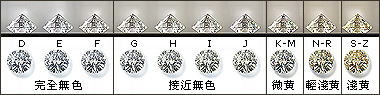
Color plays a significant role in determining the value of a diamond. Basically, except for fancy color, diamonds with less color are higher in price. Diamonds that are as clear as colorless water are the most expensive and have a D to F rating, D being the highest. As the rating descends towards Z, more color is present. The color grading scale will be Colorless (D, E, F), near colorless (G, H, I, J), very light yellow (K, L, M), very light-light yellow (N to Z) and fancy yellow (Z +).
Diamonds with a natural body color other than light yellow, light brown or light gray are called fancy color diamonds; such as pink, purplish red, green and blue. Fancy color diamonds may cost a lot more than those which are colorless.
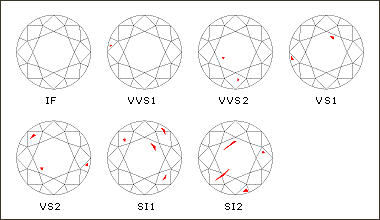
The fewer, smaller and less noticeable flaws and blemishes the higher the price of a diamond. To examine a diamond for clarity, you'll need a ten-power magnifier.The 11 GIA clarity grades are as follows:
Fl (Flawless)
No inclusions (flaws inside the diamond) and no blemishes (flaws on the surface)
IF (Internally Flawless)
No inclusion and only insignificant blemishes.
VVS1 & VVS2 (Very Very Slightly Included)
Very, very slightly included - minute flaws difficult to see with a 10X magnifier.
VS1 & VS2 (Very Slightly Included)
Very slightly included - minor inclusions ranging from difficult to somewhat easy to see under a 10X magnifier.
SI1 & SI2 (Slightly Included)
Slightly included, noticeable inclusions easy (SI1) or very easy (SI2) to see under a 10X magnifier, but that normally aren't eye - visible.
I1, I2 & I3 (Imperfect)
Eye-visible flaws face up that range from 'just visible' (I1) to 'extremely visible' to the naked eye (I3). Some I1 and I3 diamonds may be damaged by ultrasonic cleaning, and because of the inclusions, they may also be less resistant to knocks.
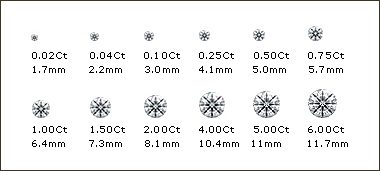
Usually, the greater the carat weight category the higher the price of a diamond. A carat is a unit of weight equaling 1/5 of a gram. The weight of a small diamond is frequently expressed in points, with one point equaling 0.01 carats. A ring with a 1-carat top quality diamond can be valued more than 10 times as much as a ring with one carat in lower color, clarity and cut quality.
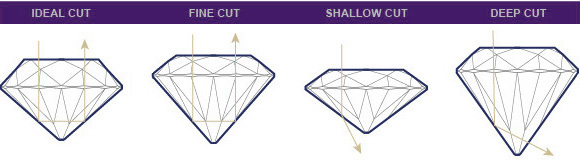
The cut of a diamond not only affects how big and brilliant it looks, it also plays an important role in determining its price. Round brilliant diamonds are commonly cut with 58 facets. The better proportioned these facets, the more light will be reflected back to the viewer's eye. When cut properly, a diamond will sparkle with more brilliance than a badly cut diamond. Diamond cuts are measured by the 'table percentage', so always ask for it. If the table size is too large, the diamond won't have much sparkle or fire. A good table percentage is between 53-60%. Cut also refers to the general shape of the diamond, such as round, oval, pear, heart, rectangle, square and marquise.
(All images are provided by MabelleLife.)